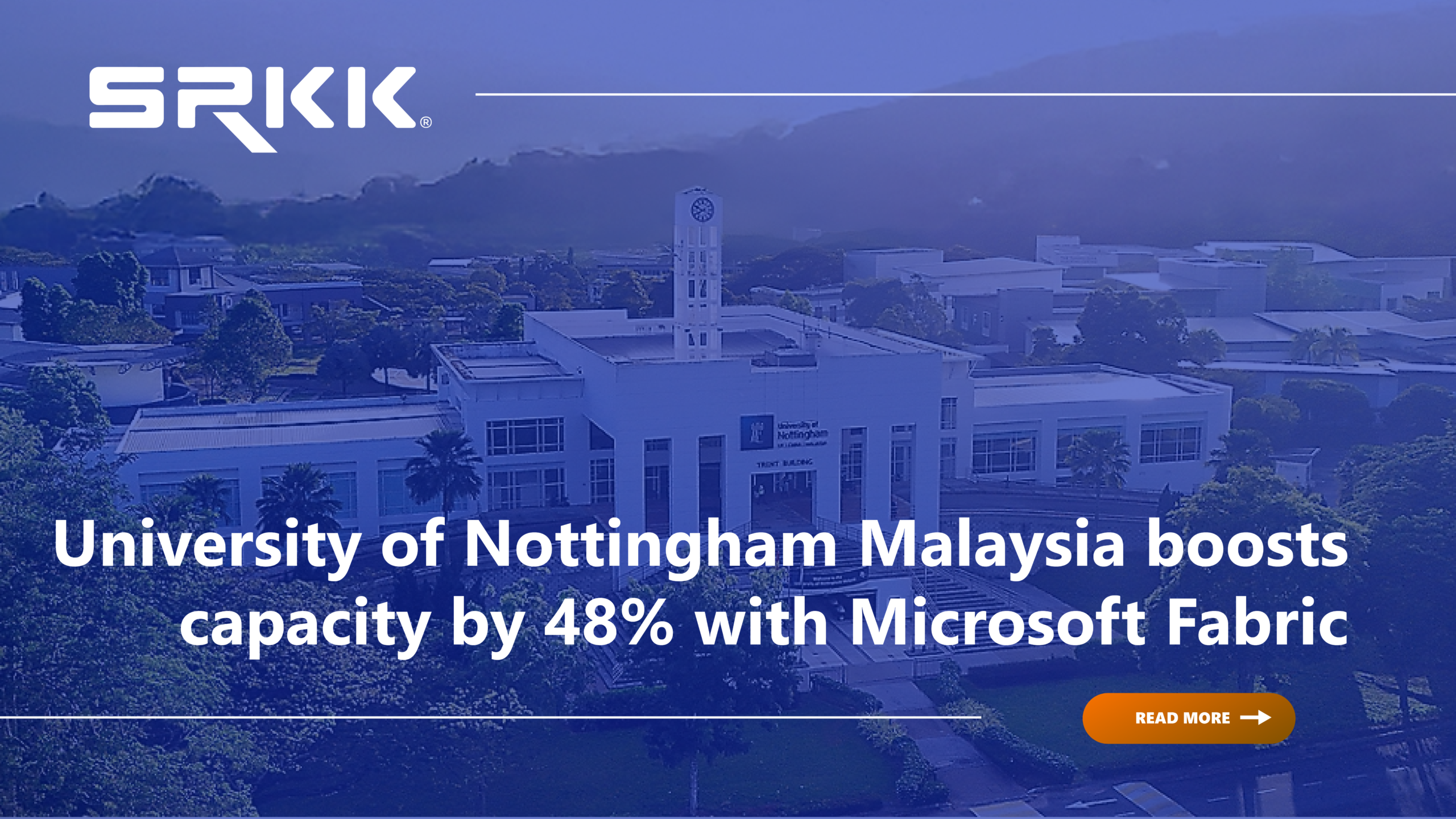
University of Nottingham Malaysia boosts capacity by 48% with Microsoft Fabric
Originally published on Microsoft Source Asia: View here
Executive Summary
UNM’s analytics team spent close to 80% of its time verifying and compiling data from siloed systems, with refresh cycles averaging 30 days and no single source of truth.
With SRKK, UNM built a governed enterprise data platform on Microsoft Fabric—OneLake storage, a Bronze/Silver/Gold medallion architecture, Lakehouse and Warehouse, and Power BI semantic models.
Data preparation time fell by more than 80%, report turnaround times improved by 60%, and 48% of team capacity was redirected to analysis. Data refresh cycles improved from monthly to near-daily.
About University of Nottingham Malaysia
The University of Nottingham is a globally recognized institution with campuses in the United Kingdom, Malaysia, and China. Established in 2000 as the first British university branch campus outside the United Kingdom, the University of Nottingham Malaysia (UNM) has played a pioneering role in advancing transnational education in Malaysia and across the region. Today, UNM is part of a top 100 global university and a member of the Russell Group, delivering a world-class British education in the heart of ASEAN.
As UNM continues to grow, so did the need for faster, more informed decision-making. UNM embarked on a digital transformation journey to modernize its operations and improve access to data across the organization, ensuring that strategic decisions were guided by accurate, accessible, and actionable insights.
The challenge: Eighty percent of the effort before the analysis began
UNM’s Strategic Analytics team sat at the center of the transformation journey but faced a fundamental challenge. To analyze the levers affecting institutional performance, the team needed clean, reliable, and unified data across multiple departments and source systems. Instead data was extracted manually and stored across disparate platforms, creating siloed datasets that were difficult to reconcile and trust.
Without a single source of truth, UNM’s leaders could not consistently rely on the available data for critical functions such as enrolment planning, recruitment tracking, and financial forecasting. As a result, the Strategic Analytics team spent nearly 80% of its time collecting, validating, and consolidating data rather than generating insights and performing value-added analysis.
Data refresh cycles averaged 30 days, meaning that by the time information reached decision-makers, opportunities to act had often passed. The university’s ability to respond to emerging trends and operational issues was constrained not by a lack of analytical capability, but by the underlying data infrastructure.
Governance challenges further compounded the problem. Decentralized data management led to inconsistent reporting, limited oversight, and gaps in data control. Unmanaged spreadsheet and email-based sharing became commonplace, while large-scale manual extraction from on-premises systems created performance bottlenecks, increased operational risk and placed additional strain on resources.
The turning point: One platform instead of many
UNM selected Microsoft Fabric as the foundation for its enterprise data platform. The decision was driven by a need for consolidation. Rather than investing in separate solutions for data integration, storage, governance, analytics, and reporting, the university sought a unified platform that could bring these capabilities together while remaining scalable, secure, and manageable by a lean team.
Fabric’s integrated software-as-a-service experience combined data engineering, data warehousing, storage, governance, and Power BI analytics within a single environment. More importantly, it enabled UNM to establish a single source of truth across admissions, student management, CRM, HR, enterprise resource planning (ERP), and other operational systems. This provided a scalable architecture to support growing data volumes, evolving business needs and future innovation.
A phased path: Build for you, build with you, build your own
UNM partnered with SRKK, which applied its three-phase enablement model rather than pursuing a disruptive, large-scale transformation. The sequencing was deliberate: deliver visible value early, minimize risk, and progressively build internal capability as the platform matured.
In the Build For You phase, SRKK deployed Microsoft Fabric and established the core enterprise data platform. Data was ingested from five strategically selected source systems to support an end-to-end pilot aligned with real operational and reporting needs. The pilot demonstrated the full data lifecycle within Fabric, from ingestion and transformation to analytics and reporting, allowing UNM’s stakeholders to see how automated, governed data pipelines could replace manual processes while validating the investment within the university’s initial technical and budgetary constraints.
In the Build With You phase, SRKK worked alongside three members of UNM’s data team through weekly on-site working sessions over a period of more than nine months. Together, they developed successive analytics use cases while applying Fabric best practices across data modelling, transformation, and reporting. The collaboration also strengthened the team’s capabilities in medallion architecture, item selection, and performance optimization. The approach reduced long-term vendor dependency while keeping institutional knowledge and ownership within the university.
In the Build Your Own phase, UNM’s Strategic Analytics team is independently developing new use cases and exploring advanced analytics and AI capabilities. Having acquired the skills to manage the full data engineering and analytics lifecycle on Fabric, the university now engages SRKK primarily as an expert advisor rather than an implementation dependency.
Inside the platform
Microsoft Fabric provided UNM with a governed analytics foundation designed to support faster, more reliable decision-making across the university. Rather than managing data integration, storage, transformation, governance, and reporting as separate workstreams, UNM brought these capabilities together within a single Fabric environment that can scale as new use cases and data domains are introduced.
At the core of the architecture, Microsoft Fabric Data Factory and on-premises connectivity bring data from source systems into OneLake, where a medallion architecture guides the flow from raw data to analytics-ready insights. Bronze, Silver, and Gold layers provide a controlled path for cleansing, standardization, validation, and enrichment. Fabric Data Engineering capabilities, including notebooks, dataflows, Spark workloads, and automated pipelines,
support the transformation process, while Lakehouse, Warehouse, data marts, and semantic models make trusted data available for reporting and analysis.
This structure also provides a strong foundation for governed self-service analytics. Power BI dashboards and reports can be built on standardized datasets, reducing reliance on manually created extracts and improving consistency across the organization. Governance capabilities such as workspace management, role-based access control, row-level security and controlled dataset access help ensure users can access appropriate data while maintaining data privacy, security, and compliance. With documented data lineage, transformation logic, and ownership, reports can be traced back to their source systems, improving transparency and confidence in institutional reporting. As a result, UNM’s Strategic Analytics team can spend less time managing data and more time delivering insights that support decision-making across the university.
What changed for UNM
The impact has been both immediate and measurable. Data preparation time has fallen by more than 80%, while report turnaround times have decreased by an estimated 60%. Ad-hoc data requests that previously took two to three weeks can now be fulfilled within one to two days.
Approximately 48% of team capacity has been redirected toward higher-value work, including strengthening the frameworks used to optimize program profitability. Data refresh cycles have improved from monthly to near-daily, shifting the university from retrospective reporting to near real-time visibility. Dashboards such as Student-at-a-Glance and Leads-to-Registration now provide stakeholders with timely visibility into key operational and enrollment metrics.
“With timely, trusted data, our team can now move beyond compiling reports and focus on helping management make sharper decisions about programmes, resources and future
priorities,” says Norihan Bahrim, Head of Strategic Analytics at UNM.
Beyond operational efficiency, the enhanced visibility and insights available through the platform have enabled Management to make more informed decisions on program portfolio management and cross-school resource allocation. For example, UNM implemented a robust framework to recognize and reward cross-teaching contributions, enabling a fair and an equitable revenue-sharing model across schools. This increased active school participation from 24% to 47%, accelerating inter-school collaboration across the university. Having a unified data platform ultimately helped UNM optimize costs, drive stronger revenue impact, and improve overall profitability.
Governance improved in parallel. Centrally managed, monitored, and traceable access replaced uncontrolled spreadsheet and email sharing, reducing data leakage risk and giving stakeholders greater confidence that reported figures are accurate, consistent, and traceable to source.
“With timely, trusted data, our team can now move beyond compiling reports and focus on helping management make sharper decisions about programmes, resources and future priorities.”
Norihan Bahrim, Head of Strategic Analytics, University of Nottingham Malaysia
The road ahead
UNM’s journey illustrates a lesson that extends well beyond one institution: successful AI transformation begins with a strong data foundation. Rather than pursuing AI initiatives in isolation, the university first focused on making its data trusted, accessible, governed, and ready for wider use.
With both the platform and internal capabilities now established, the Strategic Analytics team is shifting its focus from descriptive to prescriptive analytics. The team is currently exploring predictive models to provide deeper insight into student progression, retention, and support needs.
UNM is also exploring resource and workload planning initiatives to support more effective decisions on academic resources, teaching capacity, and cross-school teaching. These next-stage initiatives are now possible because the university first addressed the underlying data challenges that constrained its analytics ambitions.
The transformation was never solely about technology. It brought together people, processes, and technology to create a sustainable foundation for long-term success. Microsoft Fabric provided the technical foundation, while equal emphasis was placed on building internal capabilities, strengthening governance, defining data ownership, and creating repeatable data management processes.
Today, UNM is well positioned to pursue advanced analytics and AI innovation with confidence, control, and long-term sustainability.